Lorem ispum dolor sit amet
Aliquip velit do aliquip cillum proident laboris et cupidatat in ad laborum magna veniam.



Introducing CBAM
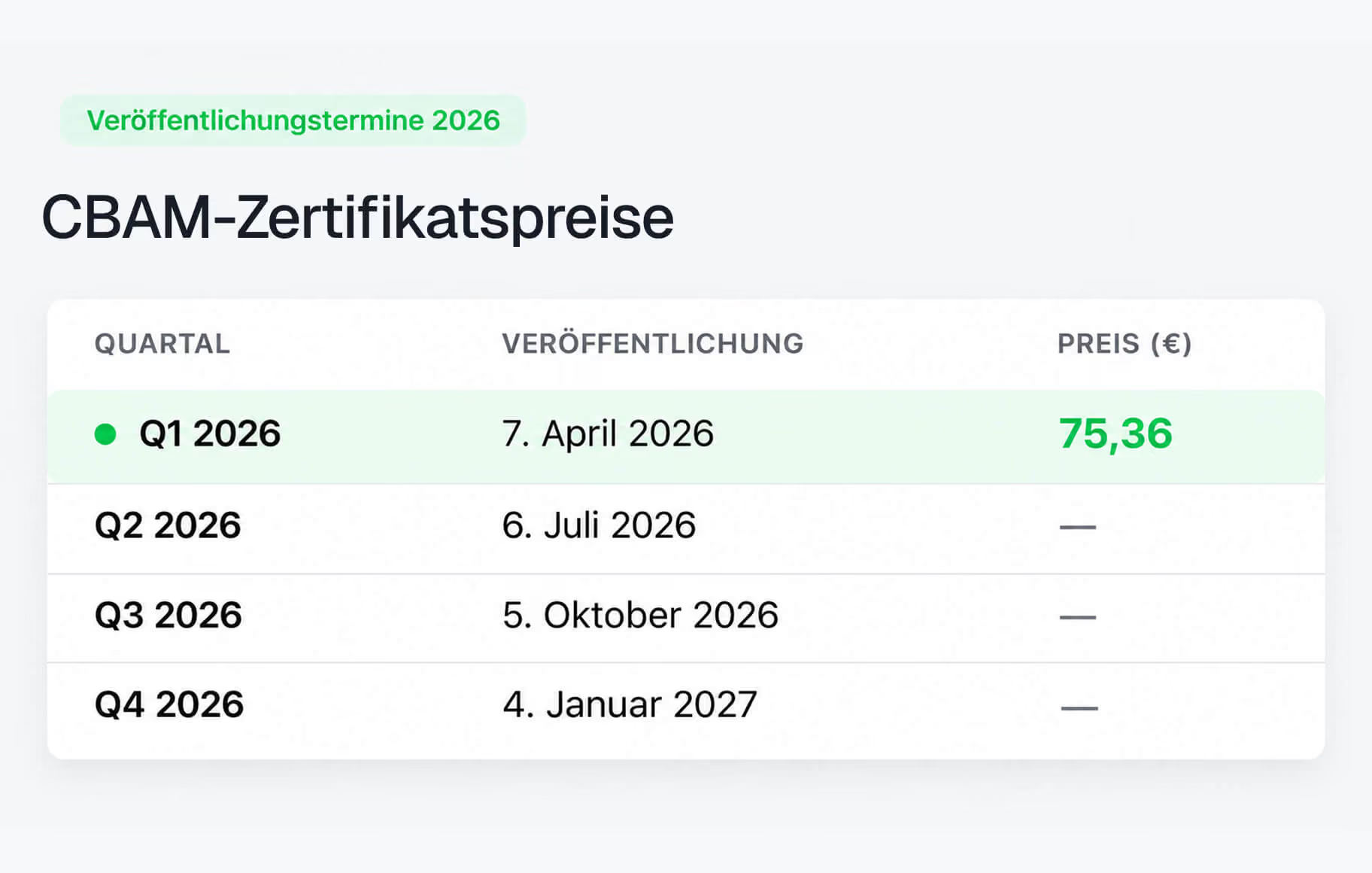
October 2023 marks the beginning of a new era in European emissions trading: the Carbon Border Adjustment Mechanism (CBAM). This system requires companies to purchase CO₂ certificates for emission-intensive imports to offset emissions at EU borders.
Who is affected by CBAM?
CBAM regulations apply to all companies within the EU that import goods listed in Annex I of Regulation (EU) 2023/956 from third countries. Note that there are exemptions for small shipments and goods from specific countries such as Switzerland, Norway, Iceland, and Liechtenstein.
Reporting obligations and methods
Companies must prepare for the following reporting obligations:
- Full reporting according to the new EU method.
- Reporting based on equivalent national systems of third countries.
- Reporting based on reference values.
These different reporting methods can be used for varying periods of time.
Transition phase and documentation
- The transition phase from 2023 to December 2025 requires companies to calculate and document emissions for quarterly reports.
- The reporting obligation lies with the customs declarant or their indirect representative if the declarant is not established in the EU.
Full implementation and expansion
- As of January 1, 2026, the trading of CBAM certificates will be fully implemented.
- During the transition phase, the Commission will assess whether to extend the scope to other goods. Organic chemicals and polymers are currently under discussion.
Key steps for companies
Companies should consider the following steps:
- Check whether goods are sourced from third countries.
- Determine the origin of these goods.
- Establish internal processes to ensure compliance with reporting requirements.
- Prepare for the transition period by grouping imports and surveying suppliers regarding CO₂ emissions.
Conclusion
The introduction of CBAM presents companies with new challenges. Thorough preparation for upcoming reporting obligations and the potential expansion of the scope is crucial to ensure compliance and avoid penalties.
About author
Maximilian Jung
Geschäftsführer
Maximilian Jung ist Geschäftsführer und Mitgründer der CBAM-Estimator GmbH. Nach seinem Studium der Volkswirtschaftslehre an der Goethe-Universität Frankfurt gründete Maximilian Jung die CBAM-Estimator GmbH, um Unternehmen dabei zu unterstützen, ihre CBAM-Verpflichtungen durch individuelle Softwarelösungen schnell und einfach zu erfüllen.