Reliable answers to your CBAM questions. From practitioners.
From impact analysis to the strategic planning of CBAM certificates: our experts provide individual advice on your CBAM obligations and develop solutions that fit your processes and supply chains.
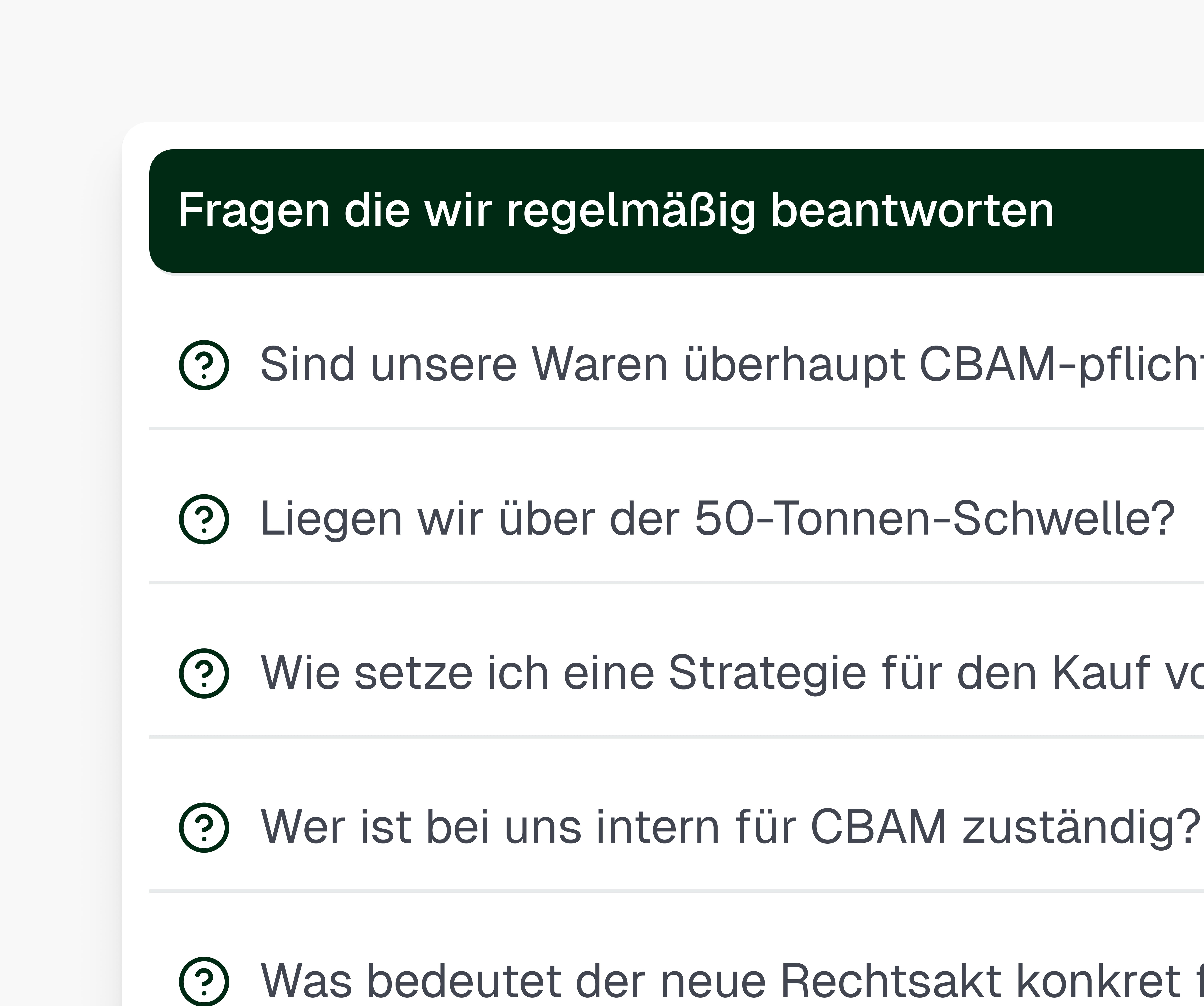
Are our goods even subject to CBAM?
Are we above the 50-tonne threshold?
How do I set up a strategy for purchasing CBAM certificates?
Who is responsible for CBAM internally?
What does the new regulation actually mean for us?
Consultation with our experts
From ongoing projects
Interdisciplinary team
Consulting and implementation
CBAM solutions for companies trading internationally.




























How we typically support you.
Our consulting services are tailored to your specific CBAM questions – from the initial impact analysis to the strategic planning of your future CBAM costs.
Impact analysis
Which goods and CN codes are subject to CBAM? Are you above or below the 50-tonne threshold?
Authorized CBAM declarant
Support with the application process and requirements for authorized declarant status.
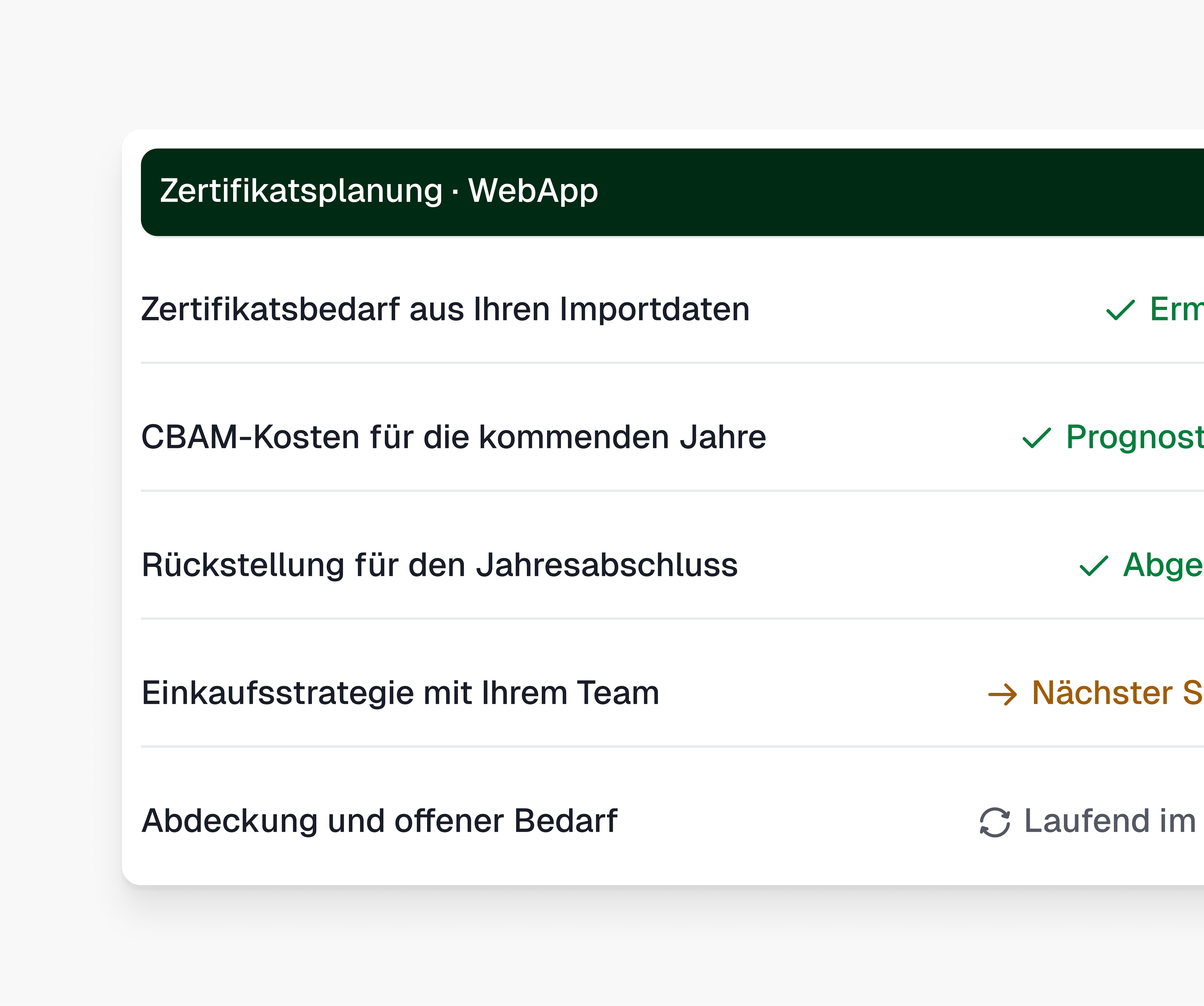
Certificate purchasing & hedging
Timing of purchases, price risks, provisions – your procurement strategy.
Internal processes
Clear interfaces between procurement, customs, finance, and compliance.
Training & workshops
Customized training for your teams on CBAM basics, obligations, and procedures.
Cost strategy
Evaluating potential savings – real data instead of default values, alternative sourcing countries.
Regulatory updates
Classifying new legal acts – and what they specifically mean for your company.
Your individual question
Flexible consulting for all CBAM topics that do not fit a standard case.
From questions to concrete solutions.
Our experts analyze your individual situation, classify the regulatory requirements, and translate them into concrete next steps for your company.
1
Analyzing the situation
We examine your imports, supply chains, processes, and specific CBAM questions.
2
Classifying requirements
We evaluate which obligations, risks, and opportunities are truly relevant to your company.
3
Deriving measures
You receive concrete recommendations for action and know exactly which steps to take next.

Understanding CBAM is good. Implementing it daily is better.
The Carbon Border Adjustment Mechanism is a highly complex set of regulations. We support you with all CBAM obligations – from report generation and emissions calculation to certificate purchasing and hedging.
Our goal: a process that is legally compliant, efficient, and practical.
We don't just know the regulations; we implement them every single day.
From ongoing projects
Our answers come from our daily work with importers and manufacturers – not from a textbook.
Interdisciplinary team
Economists, political scientists, engineers, computer scientists, and mathematicians – the right experts for every question.
Consulting and implementation
Upon request, we can also handle implementation: report generation, supplier support, certificate planning, and software.

CBAM compliance
CN codes
50-tonne threshold
Certificate planning
Emissions data
Supply chains
Cost strategy
Hedging
By the end, you will know exactly what needs to be done.
We will discuss your current imports, supply chains, and CBAM challenges to clarify exactly which requirements are relevant to your company.
We identify potential areas for action: from missing emissions data and reporting obligations to planning for future certificate costs.
Learn how we can provide concrete support through our web app, personal consulting, or by taking over specific operational CBAM tasks.
Companies trust us
From international corporations to specialized industrial firms: we help companies implement their CBAM requirements in a structured and efficient manner.
500+
Companies supported
1,000+
Suppliers contacted
30+
Countries in the supply chain
50,000+
Import processes analyzed
Additional services

Report generation & submission
You provide the import data. We handle your CBAM declaration.
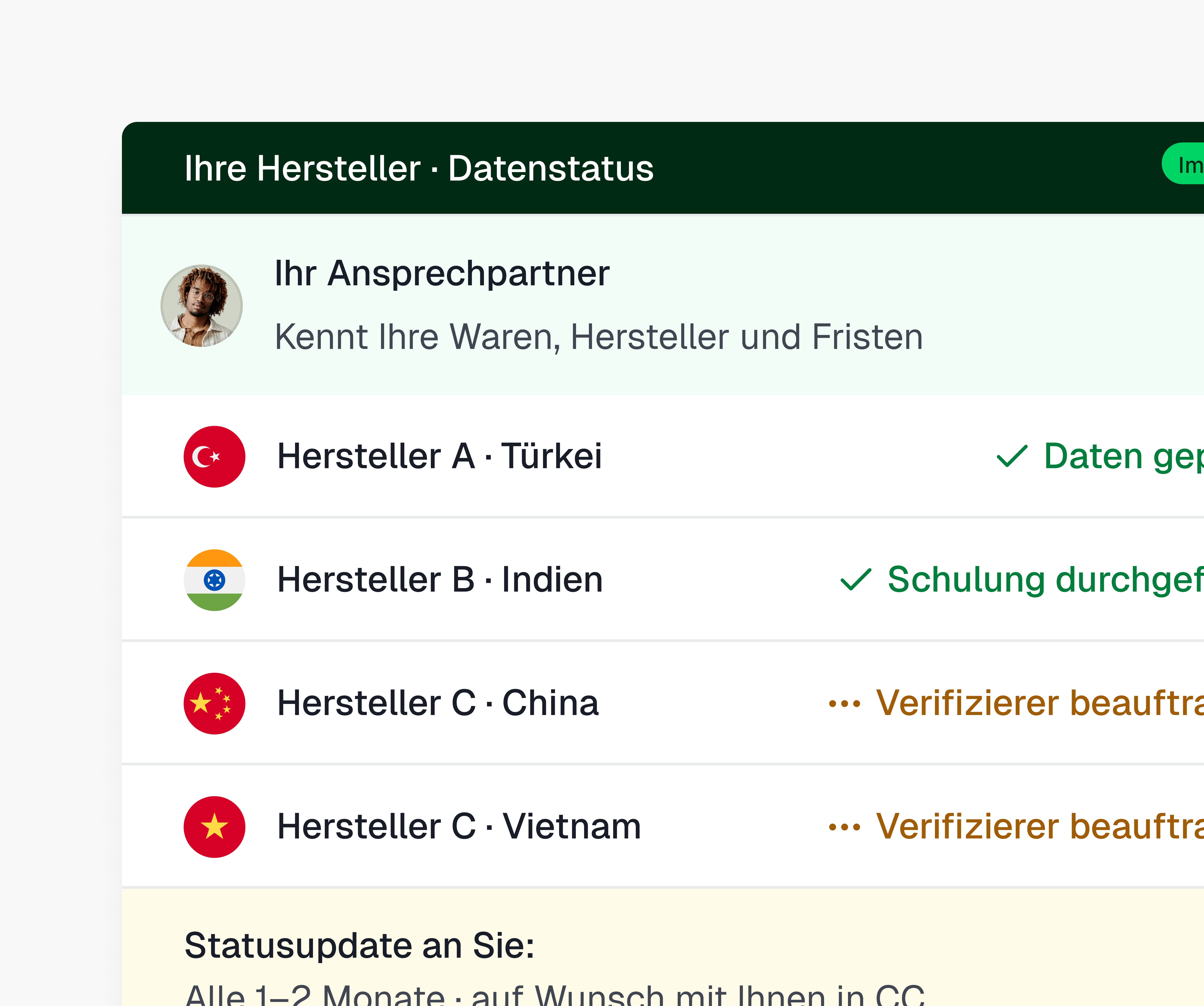
Emissions data procurement & supplier workshops
We collect emissions data from your suppliers.


UK CBAM for importers and manufacturers
Prepare your business early for the new requirements in the UK.
Frequently Asked Questions
Übernimmt CBAM Estimator nach der Beratung auch die operative Umsetzung?
Können Sie auch bei der Reduzierung zukünftiger CBAM-Kosten beraten?
Bieten Sie auch CBAM-Schulungen für unsere Mitarbeiter an?
Kann CBAM Estimator auch unsere internen Prozesse und Verantwortlichkeiten begleiten?
Beraten Sie auch zum Kauf und zur Planung von CBAM-Zertifikaten?
Unterstützt CBAM Estimator beim Status als zugelassener CBAM-Anmelder?
Wie finde ich heraus, ob und in welchem Umfang mein Unternehmen von CBAM betroffen ist?
Für welche Unternehmen ist eine CBAM-Beratung sinnvoll?